
The “$1 Trillion Truth” Kitsap Businesses Can’t Ignore
Here’s the uncomfortable reality.
Holiday shopping isn’t just “busy season.” It’s one of the biggest spending windows of the entire year and it’s getting bigger, not smaller. The National Retail Federation (NRF) forecasted 2025 holiday sales at $1.01 to $1.02 trillion, up 3.7%–4.2% from the year before. (As per source “National Retail Federation” )
Now read that again and let it land.
Over one trillion dollars moves through people’s hands during the holidays. But here’s what hurts: Kitsap businesses don’t automatically get their share of it. Not unless you understand what’s really happening inside the customer’s mind.
That’s what this blog is about.
Because the Kitsap Holiday Revenue Boost isn’t “a holiday promo idea.” It’s a psychology-based strategy built around one thing most businesses ignore:
Local spending psychology.
And if you learn how it works, you can stop begging for attention with discounts and start attracting people naturally.
Why are Kitsap customers spending differently now?
If you’re running a business in Kitsap County, you’ve probably felt it:
- People still spend… but they hesitate longer
- They check reviews harder
- They buy fewer “random extras”
- They want purchases to feel meaningful
That’s not just inflation or “tough times.”
That’s psychology.
And it matters even more in Kitsap because we’re not a big city market where people impulse shop 24/7. Kitsap is community-driven. People talk. People recognize each other. People want to feel like their money did something good.
Also, Kitsap has real spending power. Census QuickFacts shows the median household income around $98,546 (2019–2023). (As per source “U.S. Census Bureau QuickFacts (Kitsap County)” )
So the money exists. The question is:
Where does it go during the holidays?
What is local spending psychology, really?
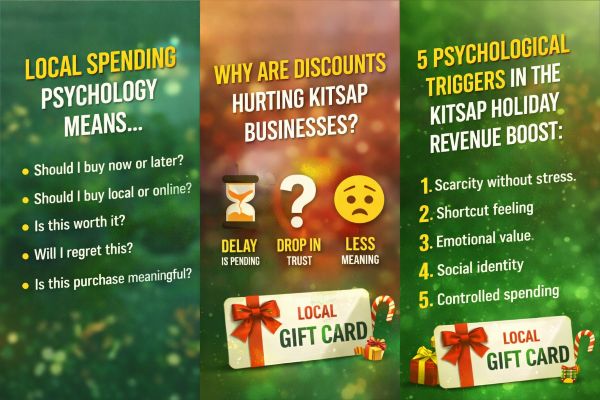
Local spending psychology is the set of emotions, mental shortcuts, and value signals people use when deciding:
- “Should I buy now or later?”
- “Should I buy local or online?”
- “Is this worth it?”
- “Will I regret this?”
- “Is this purchase meaningful?”
And during the holidays, those decisions get more intense because the customer feels pressure:
- gifting pressure
- time pressure
- money pressure
- social pressure
So they don’t behave like “normal” shoppers.
They behave like humans.
Why do people spend MORE during the holidays even when they’re stressed?
This is the part most business owners miss.
Holiday spending increases not because everyone is rich.
It increases because customers are in a different mental state.
One key concept explains it:
Mental accounting: the hidden reason holiday promotions work
Mental accounting means people don’t treat money as one big pool. They create categories in their mind like:
- “gift money”
- “holiday fun money”
- “family money”
- “my treat money”
- “end-of-year bonus money”
So they’ll spend $120 on gifts even if they’re stressed about gas prices… because in their mind it’s coming from a different “account.”
That concept is widely explained in behavioral economics. (As per source “The Decision Lab – Mental Accounting” )
This is huge for local businesses.
Because if you create the right offer, you’re not “competing with Amazon.”
You’re simply positioning yourself inside the customer’s “holiday account.”
That’s what the Kitsap Holiday Revenue Boost is designed to do.
The biggest problem: Kitsap businesses try to win with discounts (and it backfires)
Let’s be honest.
Discounts feel like the easiest lever.
But discounts create 3 dangerous psychological effects:
1) Discounts train people to delay
If people believe “prices drop later,” they wait.
And waiting kills local momentum.
2) Discounts lower trust for service businesses
In a local community, discounts can accidentally signal:
- “Are they struggling?”
- “Are they desperate?”
- “Is the quality lower?”
3) Discounts shift attention away from meaning
Holiday spending is driven by emotion and identity.
Discounts reduce it to: cheap vs expensive.
That’s a losing game against big retailers.
What customers actually want: “My money should feel like it mattered”
This is the Kitsap advantage.
Local customers often spend locally when they feel:
- pride (supporting their community)
- belonging (being part of something)
- identity (“I’m the kind of person who supports local”)
- emotional payoff (“This feels good”)
And there’s a real economic reason supporting local matters:
Research on the local multiplier effect found that about 48% of spending at local independent businesses recirculates locally, compared to less than 14% at chain stores. (As per source “AMIBA – The Local Multiplier Effect (PDF)” )
So when Kitsap shoppers spend local, it genuinely supports jobs and local stability.
When you communicate that clearly, you’re not “marketing.”
You’re giving people a reason to act.
How the Kitsap Holiday Revenue Boost matches local spending psychology
This strategy works because it aligns with 5 psychological triggers.
1) “I don’t want to miss out” (scarcity without pressure)
Kitsap people don’t like pushy sales tactics.
But they do respond to limited seasonal moments, like:
- “Holiday-only bundles”
- “Community thank-you week”
- “limited gift slots”
- “small batch drops”
The key is: soft scarcity.
Not manipulation, just seasonality.
2) “I want an easier decision” (decision fatigue)
By December, people are tired.
So the businesses that win are the ones that remove mental effort:
- clear gift options
- set bundles
- “for her / for him / for teachers”
- simple checkout
- gift cards made easy
Make buying feel like relief.
3) “I want purchases to feel personal” (emotional value)
This is why “local” wins when positioned right.
Instead of:
“10% off holiday sale”
You shift to:
“This gift supports a Kitsap maker.”
Or:
“This bundle was built for Kitsap families.”

4) “I want to look like a thoughtful person” (social identity)
This is massive in local markets.
People buy things that say something about them:
- “I support local”
- “I’m a good friend”
- “I’m a great parent”
- “I’m connected to my community”
Your marketing should help them express that identity.
5) “I want spending to feel controlled” (guilt-free budgeting)
This is why gift cards are so powerful.
Gift cards feel like:
“I handled it.”
“It’s already planned.”
“It won’t hurt later.”
And it directly ties into mental accounting.
Practical Ways Kitsap Businesses Can Use Local Spending Psychology
Here are strategies that feel natural and local (not corporate).
Create a “Kitsap Holiday Shortcut” offer
Make purchasing easier:
- 3 best sellers
- 3 price points
- ready-to-gift packaging
- clear gifting categories
Short answer (30–50 words):
Holiday buyers are overwhelmed. If your offer reduces thinking, it sells faster. Build 3–5 gift-ready options that feel like “problem solved.” That aligns directly with local spending psychology because customers want emotional value and simplicity.
Build a “community impact” message (but keep it real)
Don’t fake it. Don’t overdo it.
Just say something like:
“When you buy here, more money stays in Kitsap.”
Then back it with truth and clarity (the multiplier effect data above helps).
Run a “Give a little, get a little” gift card boost
Not a discount.
A boost.
Example:
“Buy a $100 gift card, get a $15 bonus card for YOU in January.”
That’s genius psychologically because:
- it increases purchase size
- it creates a future visit
- it feels like a reward, not desperation
FAQs about Local Spending Psychology in Kitsap County
What is local spending psychology?
Local spending psychology is the emotional and mental decision-making process customers use when choosing local businesses over chains or online retailers, especially during high-pressure seasons like the holidays.
Why do discounts fail in local communities like Kitsap?
Discounts can train shoppers to wait, reduce perceived quality, and shift the conversation from emotional value to price. In Kitsap, trust and community identity often matter more than “cheap.”
What offer works best for Kitsap holiday buyers?
Gift-ready bundles, simplified choices, and gift card boosts work best because they reduce decision fatigue and fit how people mentally budget holiday purchases.
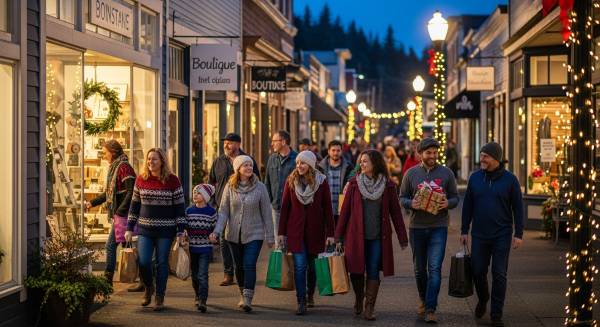
The future: Kitsap’s holiday economy will reward the businesses that feel local
Holiday growth isn’t slowing down. NRF reports show continued strong seasonal spending trends (As per source “National Retail Federation” ), and the brands that win won’t just be the loudest.
They’ll be the ones who feel:
- familiar
- trustworthy
- community-rooted
- easy to buy from
That’s why the Kitsap Holiday Revenue Boost isn’t “a campaign.”
It’s a system built on local spending psychology.
Want me to help you apply this to your Kitsap business?
If you want, I can turn this into a ready-to-run Kitsap Holiday Revenue Boost plan for your exact business type (restaurant, salon, clinic, service provider, retail).
Or better:
Drop your business name + city in the comments, and I’ll reply with 3 high-converting holiday offers based on local spending psychology.
Let’s make Kitsap the place where local wins big this holiday season.