
In holiday campaigns across the U.S., deep discounts are one of the fastest ways businesses accidentally destroy profit.
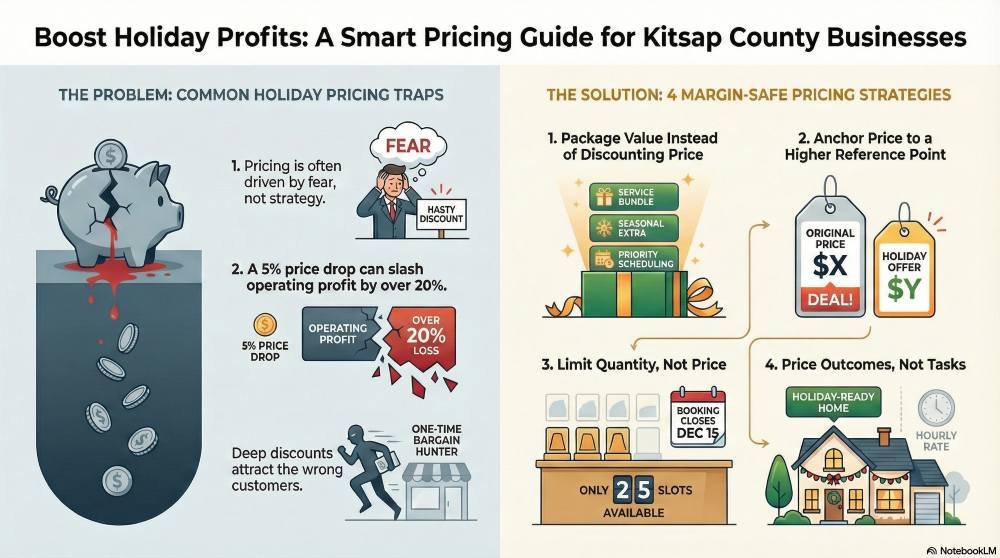
Bain and Company reports that a 5 percent drop in price can cut operating profit by more than 20 percent if volume does not rise dramatically.
That matters right now for Kitsap County businesses preparing holiday offers, because local demand is strong but margins are already tight.
This is where many holiday promotions quietly fail.
The Kitsap Holiday Revenue Boost can work incredibly well, but only if pricing is intentional. Not cheap. Not reactive. Intentional.
If you have ever run a holiday special that brought in more customers but left you wondering where the money went, this article is for you.
We will break down how to price offers for the Kitsap Holiday Revenue Boost without hurting profit margins, using real data, local realities, and pricing strategies that actually protect your bottom line.
Why Are So Many Kitsap Holiday Offers Underpriced?
Most holiday pricing mistakes come from fear.
Fear of being ignored.
Fear that customers only care about discounts.
Fear that nearby competitors are doing more.
According to the National Retail Federation, holiday shoppers value convenience, trust, and relevance just as much as price. Discounts matter, but they are not the main decision driver for most local purchases.
In Kitsap County, this is even more true. Local customers often choose businesses because they feel known, supported, and reliable. When pricing ignores that, profit gets sacrificed for no real gain.
The problem is not the Kitsap Holiday Revenue Boost itself.
The problem is how offers are priced inside it.
What Does “Kitsap Holiday Revenue Boost Without Hurting Profit Margins” Really Mean?
It means designing holiday offers that increase revenue per customer, not just foot traffic.
It means structuring pricing so your business wins even if volume stays the same.
It means using perceived value instead of raw discounts.
This approach is especially important for service businesses in Silverdale, Poulsbo, Bremerton, Port Orchard, and surrounding areas where time, labor, and capacity are limited.
The Biggest Holiday Pricing Myth Hurting Kitsap Businesses
“If I don’t discount heavily, people won’t buy.”
This belief is widespread and incorrect.
Harvard Business Review research shows customers are more responsive to bundled value and clarity than price cuts alone. When people understand exactly what they are getting and why it matters, they are willing to pay more.
In Kitsap County, this shows up every holiday season.
Businesses that simply lower prices often attract bargain shoppers who disappear in January.
Businesses that frame value attract customers who come back.
How to Price Offers for the Kitsap Holiday Revenue Boost Without Hurting Profit Margins
Start With Contribution Margin, Not List Price
Before setting any holiday offer, ask one question.
How much does each sale contribute after direct costs?
This includes materials, labor, fulfillment time, and transaction fees.
The Small Business Administration emphasizes contribution margin as a core pricing metric because revenue without margin is not growth.
If you do not know this number, holiday pricing becomes guesswork.
Short answer
If an offer does not maintain contribution margin, it does not belong in your holiday campaign.
Use Packaging Instead of Discounting
Packaging is one of the safest ways to run a Kitsap Holiday Revenue Boost without hurting profit margins.
Instead of lowering price, increase what is included.
Examples that work well locally include
Service bundles with a clear time window
Seasonal add-ons that use existing inventory
Priority scheduling during high-demand weeks
Customers see more value. Your cost increase stays minimal.
This is how many Kitsap service providers quietly raise average order value during the holidays.
Anchor Pricing With a Higher Reference Point
People evaluate price based on comparison, not math.
According to behavioral pricing studies from the University of Chicago, customers rely heavily on the first price they see as a reference point.
For holiday offers, this means clearly showing the regular price first.
Then present the holiday version as easier, faster, or more complete.
This approach protects margin while still creating urgency.
Limit Quantity, Not Price
One of the most effective margin-safe strategies in the Kitsap Holiday Revenue Boost is scarcity based on availability.
Examples
Only 25 holiday slots available
Booking closes before December 15
Available to returning customers first
Scarcity increases demand without requiring a discount.
This aligns perfectly with local service businesses that already operate near capacity during winter months.
Build Pricing Around Outcomes, Not Tasks
Customers do not buy tasks. They buy outcomes.
This matters especially in Kitsap County where trust plays a big role in purchasing decisions.
Instead of pricing by hours or line items, frame your holiday offer around results.
Examples
“Holiday-ready home”
“Year-end business reset”
“Winter safety check”
Outcome-based pricing allows you to charge more without resistance because the value feels clear and personal.
Real Kitsap Holiday Pricing Patterns That Protect Profit
Local businesses that succeed with holiday pricing tend to share three traits.
They avoid blanket discounts.
They design offers around convenience.
They communicate value clearly and simply.
According to a Washington State Department of Commerce small business survey, locally owned businesses that focus on bundled services and limited-time access outperform those that rely on price cuts alone during seasonal campaigns.
This is especially true in counties like Kitsap where word-of-mouth and repeat customers matter.
How to Adjust Pricing for Different Kitsap Business Types
Service Businesses
Service providers often hurt margins by underestimating labor during holidays.
Pricing should include buffer time and seasonal demand.
Holiday offers should emphasize scheduling priority and bundled outcomes, not lower hourly rates.
Retail and Product-Based Businesses
Retailers should focus on curated sets instead of individual item discounts.
Holiday kits, local gift bundles, and themed collections raise perceived value while protecting margin.
Home and Trade Services
For home services, pricing should factor in winter conditions and limited daylight.
Holiday pricing that guarantees faster service or bundled safety checks performs better than discounts.
What Happens When You Price the Kitsap Holiday Revenue Boost Correctly?
Revenue becomes predictable.
Customers feel respected, not rushed.
January does not feel like a financial hangover.
McKinsey research shows businesses that maintain pricing discipline during peak seasons outperform competitors over a three-year period, even if short-term sales appear lower.
In local markets like Kitsap County, this long-term effect is even stronger because relationships carry more weight than impulse purchases.
Common Mistakes to Avoid During Holiday Pricing
Dropping prices without adjusting scope
Copying competitor discounts blindly
Ignoring capacity limits
Failing to communicate value clearly
Each of these leads to burnout, not growth.
The Future of Holiday Pricing in Kitsap County
The Kitsap Holiday Revenue Boost is evolving.
Customers are becoming more intentional. They want local. They want reliable. They want clarity.
Businesses that price with confidence will stand out.
Those that race to the bottom will struggle to recover.
The goal is not to be the cheapest option.
The goal is to be the easiest and most trusted choice.
Final Thoughts
If you want the Kitsap Holiday Revenue Boost without hurting profit margins, pricing must support your business, not sabotage it.
Holiday offers should feel generous but controlled.
Festive but grounded.
Urgent but sustainable.
That balance is where real growth lives.
If you are planning a holiday campaign this season and want help structuring offers that actually protect profit, share your thoughts or questions in the comments. Let’s make this holiday season work for Kitsap businesses, not against them.